
Inquiries about BIM certifications in the construction industry have risen noticeably over the past few years. Since the Ministry of Land, Infrastructure and Transport (MOLIT) announced a roadmap to phase in mandatory BIM on publicly ordered projects, the number of people looking to certifications as a way to prove their practical skills has surged. Yet if you actually search for “BIM certification,” the issuing bodies and grade structures all differ, and it is hard to know where to start checking. This post lays out the full landscape of BIM-related certifications in Korea, how to prepare for the exams, and the ongoing discussion about national accreditation.
1. Why Is BIM Certification in the Spotlight Now?
In December 2020, MOLIT announced the “Construction Industry BIM Basic Guidelines” (건설산업 BIM 기본지침) and the “2030 Architectural BIM Activation Roadmap” (2030 건축 BIM 활성화 로드맵), setting out a direction of phasing in mandatory BIM across the entire lifecycle of the construction industry, from survey and design through ordering, procurement, construction, supervision, and maintenance. In July 2022, the “Construction Industry BIM Implementation Guidelines” (건설산업 BIM 시행지침), which also covers how to prepare, deliver, and use deliverables, was released as a supplement, and this trend became more concrete.
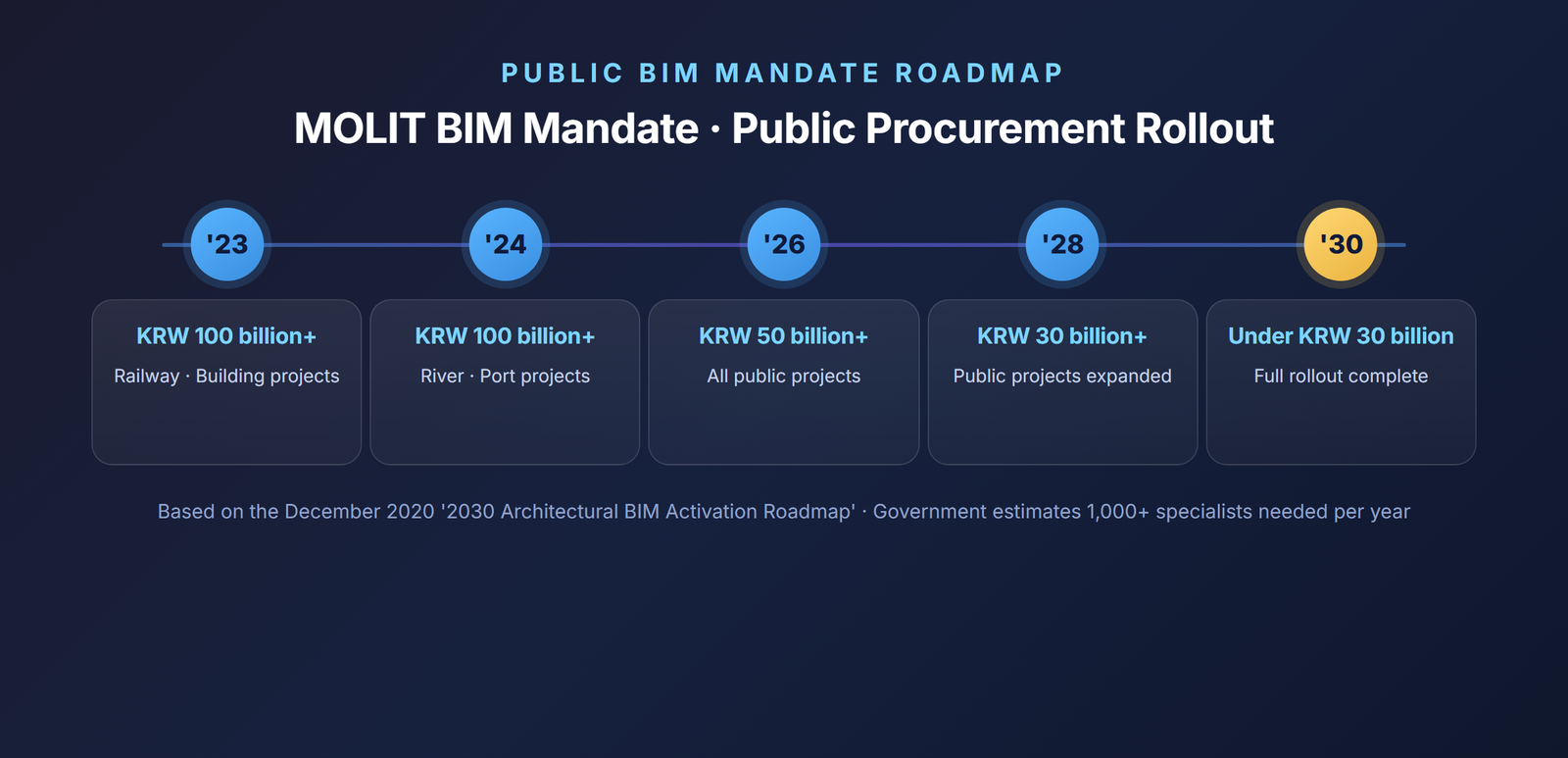
The roadmap for mandatory BIM in public procurement is also tightly scheduled. According to press reports, BIM application is set to expand fully: starting in 2023 with railway and building projects of KRW 100 billion or more, then river and port projects of KRW 100 billion or more in 2024, all public projects of KRW 50 billion or more in 2026, projects of KRW 30 billion or more in 2028, and public projects under KRW 30 billion in 2030. At this pace, it is no surprise that the government estimates it needs more than 1,000 BIM specialists supplied every year. In the end, this policy pressure led to a surge in demand to sit for private BIM certification exams, and at the same time triggered moves to elevate them to nationally accredited certifications.
2. Why Are BIM Certifications in Korea So Complicated? A Map of the Three-Track System
There is one fact to make clear first. As of September 2026, there is no standalone certification with “BIM” in its name within the National Technical Qualification system (Q-Net). Instead, three different certification systems operate side by side.
- ① Private registered certification: “BIM Expert” and “BIM Operations Expert,” co-developed by the Korean BIM Society (한국BIM학회) and Hansol Academy (한솔아카데미)
- ② MOLIT-recognized certification (as labeled by the association): buildingSMART Korea’s five-level certification system
- ③ Plus Certification: a system that adds BIM competency to existing National Technical Qualifications
In other words, you are not simply earning “one BIM certification”; you first need to pick the system that fits your goals and career stage. Note also that existing National Technical Qualifications such as Craftsman Computer-Aided Architectural Drafting, Engineer Architecture, and Architect only cover CAD drafting and architectural practice in general and are not BIM-specific certifications, so be careful not to confuse them.
3. Korean BIM Society and Hansol Academy — “BIM Expert” and “BIM Operations Expert”
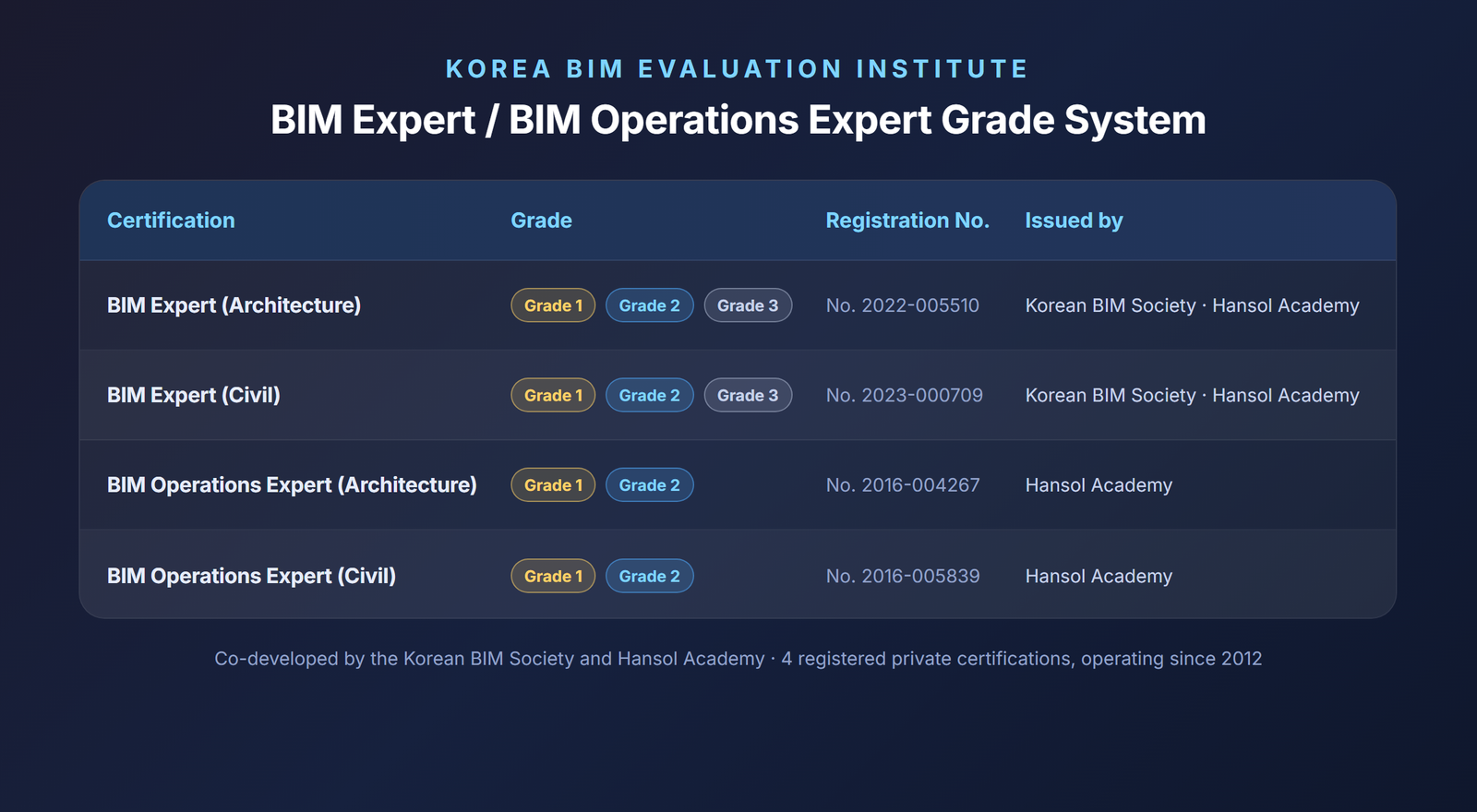
The Korean BIM Society, an incorporated association, and Hansol Academy Co., Ltd. have co-developed these certifications since 2012, and the following four registered private certifications are operated through the issuing body, the Korea BIM Evaluation Institute (한국BIM평가원).
| Certification | Grade | Registration No. | Issued by |
|---|---|---|---|
| BIM Expert (Architecture) | Grade 1 / 2 / 3 | No. 2022-005510 | Korean BIM Society · Hansol Academy |
| BIM Expert (Civil) | Grade 1 / 2 / 3 | No. 2023-000709 | Korean BIM Society · Hansol Academy |
| BIM Operations Expert (Architecture) | Grade 1 / 2 | No. 2016-004267 | Hansol Academy |
| BIM Operations Expert (Civil) | Grade 1 / 2 | No. 2016-005839 | Hansol Academy |
One caveat is worth noting here. Daehan Economy (대한경제) describes it as “about 1,600 BIM Operations Experts produced between 2013 and 2022,” whereas Engineering Daily (엔지니어링데일리) gives the figures “a cumulative 2,903 certified over 13 years across all private BIM certifications administered by the Korean BIM Society, with 3,003 examinees and 661 passers over the last three years.” The two outlets likely used different collection periods and certification scopes (BIM Operations Expert only vs. all BIM certifications), so rather than trusting only one number, it is safer to simply be aware that both figures coexist.
“A cumulative 2,903 certified over 13 years, 3,003 examinees and 661 passers over the last three years” — statistics on Korean BIM Society-administered certifications, as cited by Engineering Daily
4. buildingSMART Korea — A Five-Level BIM Certification System
buildingSMART Korea operates, in cooperation with the Korea Digital Education Institute (한국디지털교육원), a five-level certification system that runs from modeler to manager.
| Level | Category | Scope of Work (Summary) |
|---|---|---|
| BIM Modeler | Registered private certification | BIM modeling, creating family geometry |
| BIM Technician | MOLIT certification (as labeled by the association) | Practical modeling and verification, 3D design permitting, construction process simulation |
| BIM Coordinator | MOLIT certification (as labeled by the association) | BIM planning and template design, overseeing integrated design-construction collaboration |
| BIM CM Coordinator | MOLIT certification (as labeled by the association) | Overall lifecycle BIM management for construction management (CM) |
| BIM Manager | Registered private certification (exam in preparation) | Overall management of BIM projects from the owner’s perspective |
One point deserves attention. The association’s website labels BIM Technician, BIM Coordinator, and BIM CM Coordinator as “MOLIT certifications,” but no clear legal basis has been found to confirm whether this means an official National Technical Qualification listed in Q-Net or a private program that MOLIT recognizes or sponsors. In other words, you can quote the association’s labeling as is, but you should not assert that it “is equivalent to a National Technical Qualification.” If you are considering taking the exam, you need to check with the association directly on exactly what this label means.
5. The Plus Certification System — Adding BIM Competency to an Existing Certification
The “Plus Certification System” (플러스자격 제도), administered by the Ministry of Employment and Labor and the Human Resources Development Service of Korea, is a system in which a holder of a National Technical Qualification who acquires a new job competency that can be integrated with that qualification has it marked on the existing certificate. Within this framework, the Korea Construction Engineering Association (한국건설엔지니어링협회) is running a pilot project called the “Civil BIM Plus Certification.” Incumbent workers who hold a National Technical Qualification such as Industrial Engineer Civil Engineering or Engineer Civil Engineering and have at least five years of practical experience complete five weeks of training in new BIM-related technologies and, if they pass the assessment, have BIM job competency added to their existing certificate. The Korea Construction Engineering Association has also signed a memorandum of understanding (MOU) with the Human Resources Development Service of Korea and is promoting the project jointly.
This system differs in nature from the two systems introduced above. Rather than a “certification you earn for BIM alone,” it layers BIM competency on top of a National Technical Qualification you already hold, which makes it a better fit for civil engineering practitioners who already have experience.
6. Will National Accreditation Really Happen? Progress So Far and Opposition
The question asked most often about BIM certifications is, “Is this a nationally accredited certification?” To give the conclusion first, as of September 2026 there is no evidence that would let us answer that question with a clear “yes” or “no.”
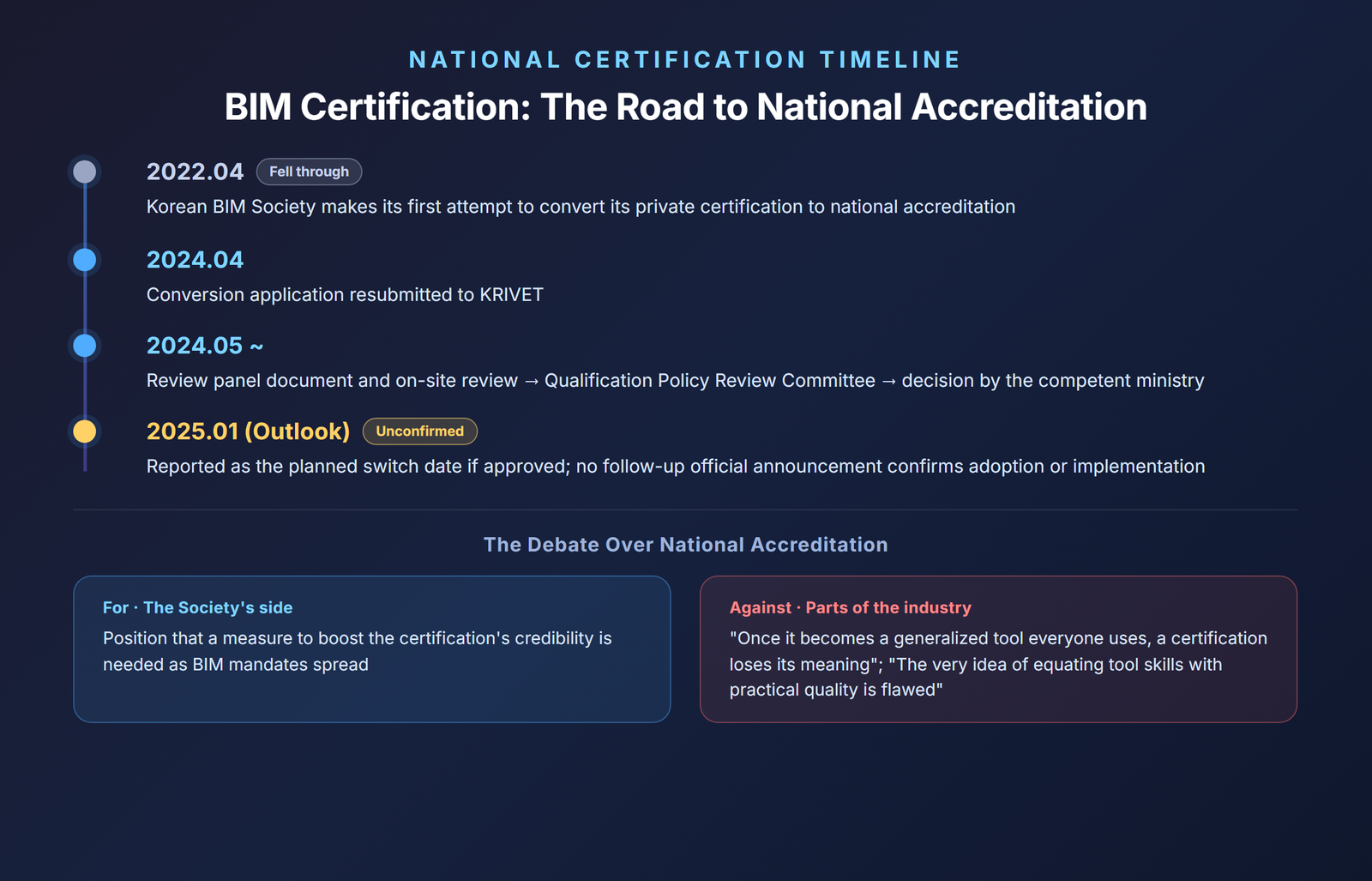
Here is the timeline. The Korean BIM Society first tried to convert its private certification to national accreditation in April 2022, but the attempt fell through. At the end of April 2024, it resubmitted its conversion application to the Korea Research Institute for Vocational Education and Training (KRIVET; 한국직업능력개발원), restarting the effort. The review follows a process in which a review panel formed by KRIVET conducts document and on-site reviews, then the Qualification Policy Review Committee deliberates, and the competent ministry makes the final decision. As of a May 2024 report, results could come out around November to December that year, and there was even an outlook that, if approved, the certification would be “converted to a nationally accredited certification in January 2025.” However, this research found no subsequent official announcement supporting actual confirmation or implementation. Therefore, while it is true that “national accreditation was pursued,” stating that “national accreditation has been confirmed” currently lacks sufficient basis.
Opinion on this issue is also sharply divided. The Society’s position is that it is a measure to expand credibility in step with the spread of BIM mandates, while some in the industry raise concerns such as the following.
“Once it becomes a generalized tool everyone uses, a certification loses its meaning,” “The very idea of equating tool skills with practical quality is flawed” — opposing views from the industry, as reported by Engineering Daily
If national accreditation actually happens, the certification’s official standing in public bidding evaluations and similar processes could be strengthened, but at the same time there are concerns that evaluating personnel by whether they hold a certification could become uniform. buildingSMART Korea is also pursuing an R&D project toward accrediting its certification system, but a 2023 report suggested that it would take considerable time before this is codified into law.
7. How Should You Prepare for the Exam?
Eligibility: Under the Korea BIM Evaluation Institute’s “BIM Expert” criteria, Grade 3 has no eligibility restrictions. Grade 2 applies to graduates (or expected graduates) of relevant college or university programs, people with at least two years of practical experience, and those who have completed accredited training. Grade 1 applies to those with practical experience or accredited training completion after obtaining Grade 2, or those with at least six years of experience in a related field. However, the official qualification-criteria PDF on the same site describes the Grade 2 eligibility more simply as “a high school diploma or higher,” so be aware that the wording differs from page to page. In other words, before you submit an application, you must confirm the details against the notice for that exam session. For the eligibility requirements of the buildingSMART Korea certifications (BIM Technician, BIM Coordinator, and BIM CM Coordinator), refer to the table in Section 4 above.
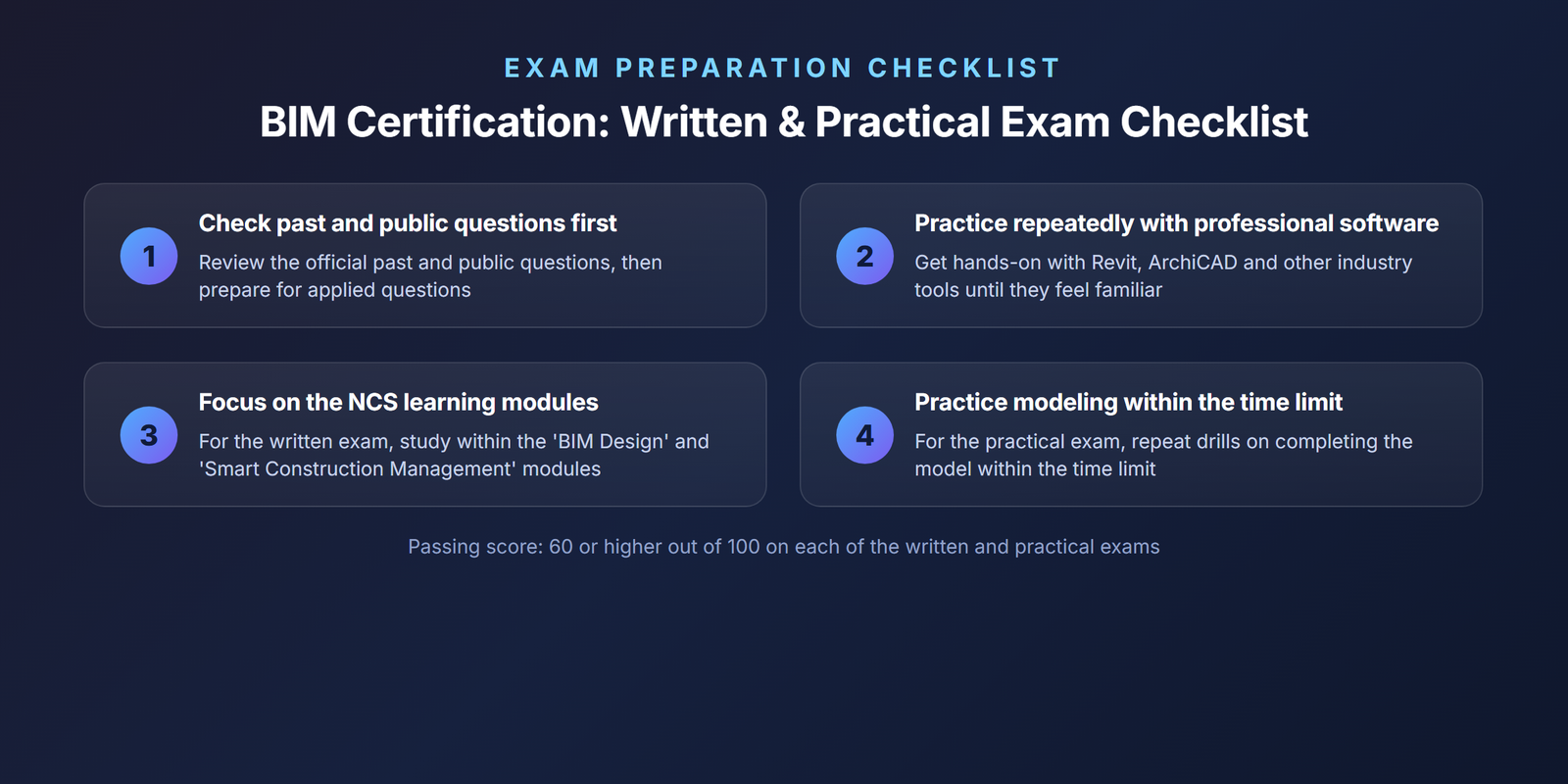
Exam subjects and format: The written exam is based on the National Competency Standards (NCS) learning modules “BIM Design” and “Smart Construction Management,” and for the practical exam you choose either GRAPHISOFT ArchiCAD or AUTODESK Revit. This format is common to both the Korea BIM Evaluation Institute and buildingSMART Korea certifications. The passing criterion is a score of at least 60 out of 100 on each of the written and practical exams.
Exam fees: For buildingSMART Korea, BIM Technician costs KRW 25,000 for the written exam and KRW 50,000 for the practical; BIM Coordinator costs KRW 30,000 for the written and KRW 60,000 for the practical; and BIM CM Coordinator costs KRW 30,000 for the written and KRW 40,000 for the practical. For the Korea BIM Evaluation Institute, Grade 1 costs KRW 50,000 for the written and KRW 150,000 for the practical, Grade 2 costs KRW 25,000 for the written and KRW 60,000 for the practical, and Grade 3 is a combined written-and-practical exam costing KRW 60,000.
Preparation strategy: The strategies confirmed in common across multiple sources are as follows.
- Check official past exam and public sample questions first, then prepare for applied questions
- Practice repeatedly with professional software such as Revit and ArchiCAD
- For the written exam, focus your study on the scope of the NCS learning modules
- For the practical exam, repeatedly practice completing a model within the time limit
Hansol Academy (bim.inup.co.kr) runs related online courses, and completing a regular training program is itself recognized as one of the eligibility requirements for some grades. I should also note that promotional academy content touting a “guaranteed pass” was judged to be advertising and was not used as a basis for this post.
8. Does Earning a Certification Actually Help?
As mandatory BIM in public procurement expands in phases, many in the industry say that certifications are becoming more important as a way for design firms and contractors to demonstrate practical BIM skills. There are also reports that public institutions such as the Korea Expressway Corporation and the Korea Rail Network Authority factor BIM certification holding into bid evaluations, and industry comments suggest that higher grades, such as Grade 1 or Coordinator level and above, tend to be favored in project management and oversight roles.
But that is not the whole story. A more cautious view, that “a certification alone is not enough; it takes domain knowledge, practical ability, and a portfolio behind it to have real effect,” also keeps coming up in interviews with industry insiders. In the end, it is reasonable to take a certification as one reference indicator of practical ability that cannot substitute for the ability itself.
Conclusion
We have looked at the three-track system of BIM certifications in Korea (private registered certifications, buildingSMART Korea’s five-level certifications, and the Plus Certification system), how to prepare for the exams, and the debate surrounding national accreditation. There are two key takeaways. First, BIM certification is not a single system but a set of different schemes from which you should choose according to your purpose and career stage. Second, all that can be confirmed about national accreditation is that it is “being pursued”; whether it will be confirmed remains uncertain.
Given how mandatory BIM is spreading across the industry, preparing for a certification can itself be a reasonable choice. But rather than jumping to conclusions about information that is still unsettled, such as whether national accreditation will happen or the legal status of a particular grade, the priority should be the habit of checking the latest information directly through the official notice at the time of application and the issuing body’s website. Keeping in mind that a certification is a tool that supports practical competitiveness, not an end in itself, we should keep watching the upcoming discussion on national accreditation and changes to the system.