
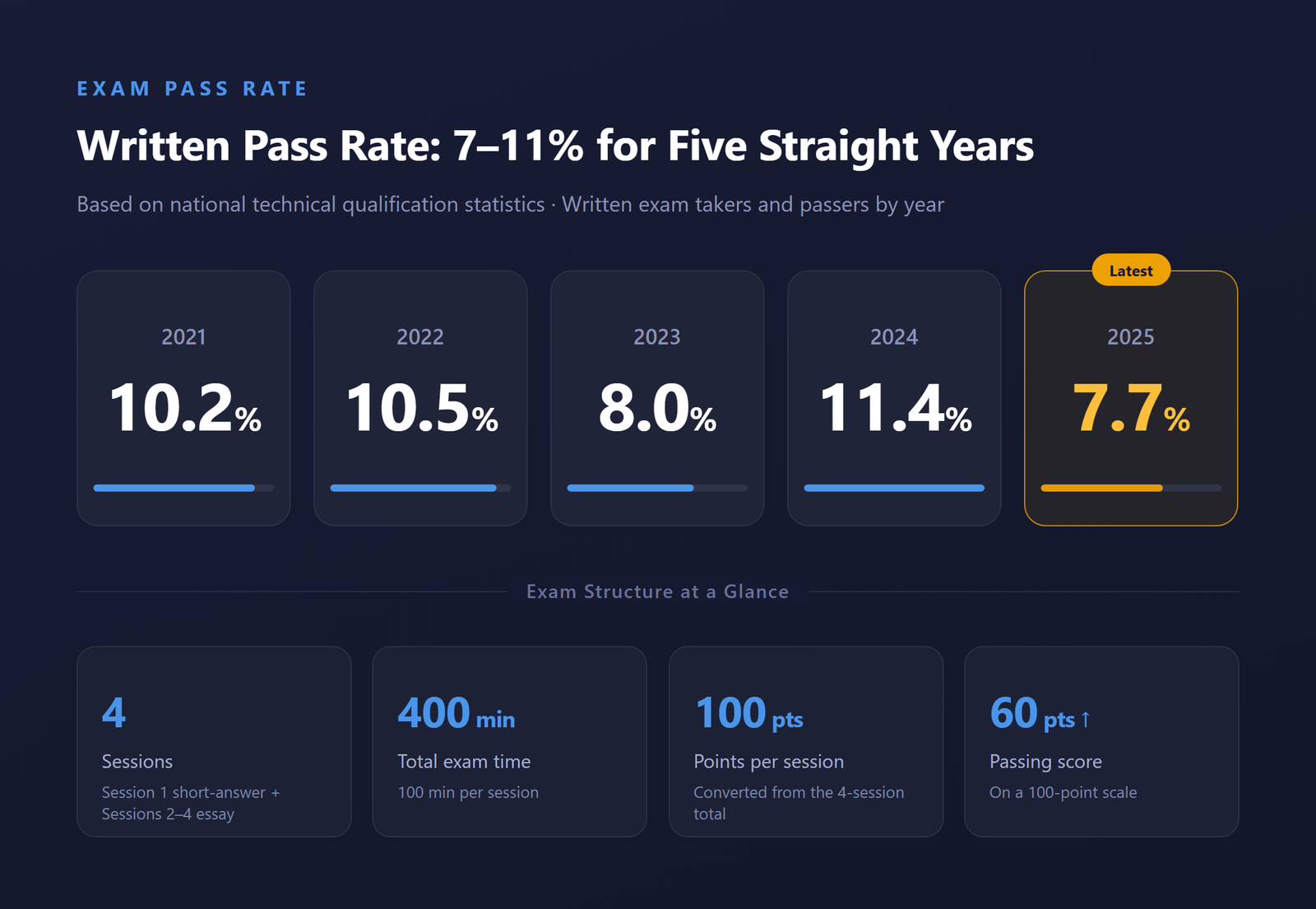
The written-exam pass rate for Korea’s Civil Engineering Execution Professional Engineer (PE) exam (토목시공기술사) has stayed in the 7–11% range for each of the last five years. That shows this is not an exam you can clear just by “working hard”; it is a gate you cannot get through without a deliberate strategy. The problem is that many candidates build that strategy on gut feeling. They skim the entire, vast field of construction based on nothing more than fragmentary impressions such as “I hear tunnels come up a lot these days” or “there seem to be more safety questions lately.”
In this post, I would like to work through Pareto data from a complete analysis of all 1,395 items across 45 exam rounds of past questions, from the 96th through the 140th. I will show which work types truly dominate the exam by a wide margin, and point out the “dangerous misconception” hiding behind those numbers.
1. A Written Pass Rate of 7%: What Makes This Exam So Hard?
The Civil Engineering Execution PE exam is a national technical qualification under the jurisdiction of the Ministry of Land, Infrastructure and Transport and administered by the Human Resources Development Service of Korea (HRD Korea) through Q-net. The written exam runs over four sessions of 100 minutes each, for a total of 400 minutes (6 hours 40 minutes). Session 1 is short-answer, where you choose 10 of 13 questions, while Sessions 2, 3, and 4 are essay-type, where you choose 4 of 6 questions in each. As with other PE fields, the combined score of the four sessions is converted to a 100-point scale, and you need 60 points or more to pass.
The problem is the pass rate. The statistics for the last five years show just how punishing this exam is.
| Year | Written Takers | Written Passers | Written Pass Rate | Practical Pass Rate |
|---|---|---|---|---|
| 2021 | 2,572 | 262 | 10.2% | 63.8% |
| 2022 | 2,370 | 249 | 10.5% | 66.6% |
| 2023 | 2,716 | 217 | 8.0% | 62.0% |
| 2024 | 2,830 | 323 | 11.4% | 64.8% |
| 2025 | 3,113 | 240 | 7.7% | 64.5% |
The practical (interview) pass rate is relatively generous at 62–67%, while the written pass rate has never moved out of the 7–11% range. In other words, “just reaching the interview is already half the battle.” Ultimately, the written exam is where the contest is decided, and to get past it, the focus you bring to choosing where to spend your time across the vast field of construction is the decisive variable that separates pass from fail.
2. Why I Took Apart All 45 Past Exams
Most candidates skim only “the last few rounds” of past questions. But looking at just a few rounds makes it hard to tell whether a particular field clustered by chance or is a core field that recurs structurally. So for this analysis, I changed the approach itself. Instead of treating each round as a “separate exam paper to study,” I treated all 45 rounds as a single dataset and dissected it statistically.
Here is the method. I obtained the complete question papers for the 45 rounds from the 96th through the 140th, held between roughly 2012 and 2026. For the scanned papers with no text layer (the 99th, 100th, 101st, and 102nd rounds), I read the original images directly and converted them to text. Each round presents 31 items on the paper: 13 questions in Session 1 and 6 questions in each of Sessions 2, 3, and 4. So 45 rounds × 31 items yielded 1,395 detailed question items in total. I then grouped similar topics by keyword into 30 work types and fields and tallied the frequencies.
In other words, this analysis is not built on “gut feeling”; it is the result of treating 45 years’ worth of exam papers as data and turning it inside out.
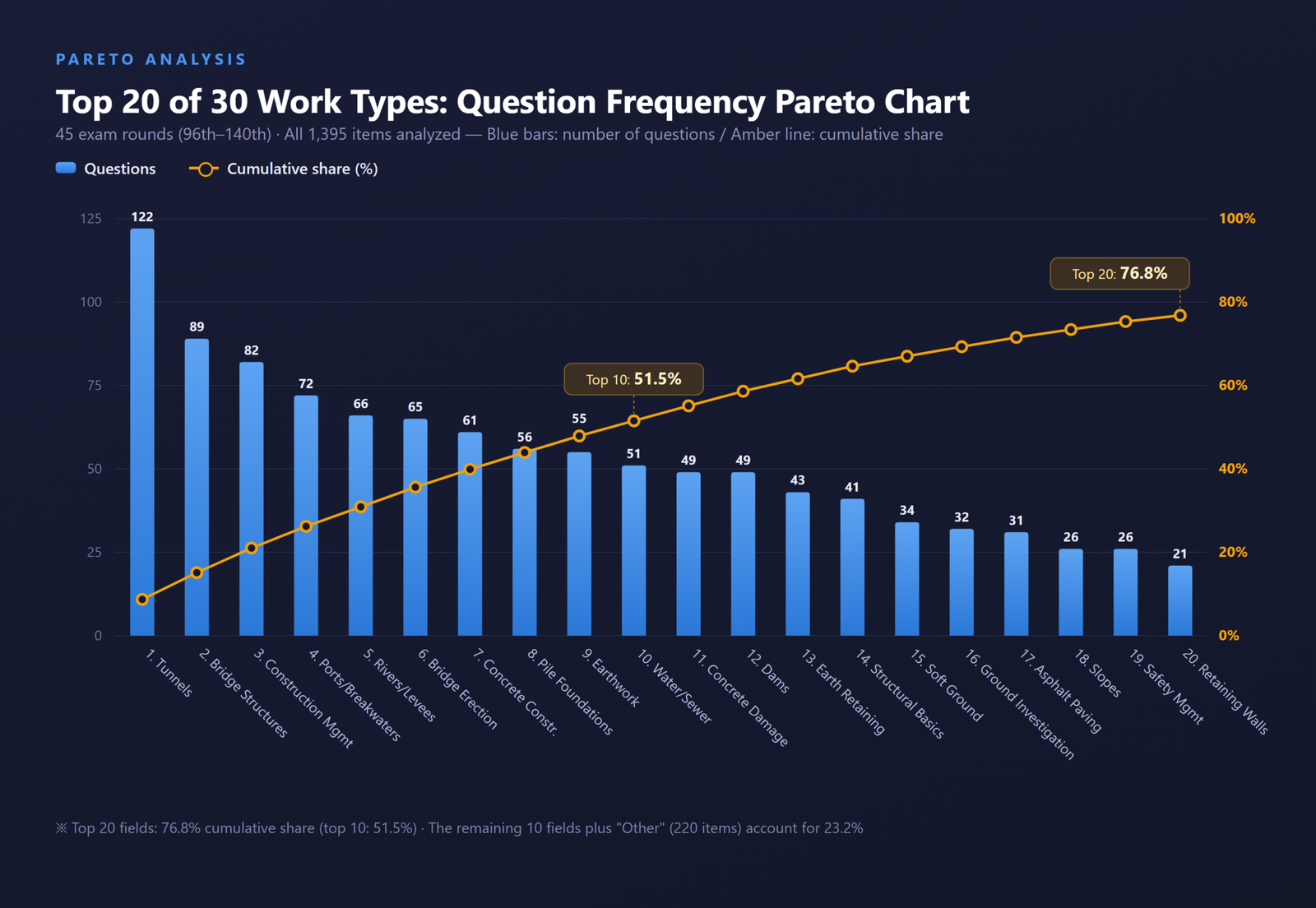
When this organized data is sorted by number of questions and the cumulative share is calculated, the distribution comes close to the well-known “Pareto principle (20% of causes produce 80% of results).”
3. Frequency Table of the Top 30 Work Types
Grouping all 1,395 items into 30 work types gives the following results.
| Rank | Field (Topic) | Questions | Share | Cumulative Share | Exams Featured (of 45) |
|---|---|---|---|---|---|
| 1 | Tunnels (NATM/TBM/Shield) | 122 | 8.7% | 8.7% | 44 |
| 2 | Bridge Structures/Maintenance | 89 | 6.4% | 15.1% | 41 |
| 3 | Construction Management/Scheduling, Contracts & Cost Estimation | 82 | 5.9% | 21.0% | 38 |
| 4 | Ports/Breakwaters/Dredging/Caissons | 72 | 5.2% | 26.2% | 41 |
| 5 | Rivers/Levees/Revetments/Check Dams | 66 | 4.7% | 30.9% | 33 |
| 6 | Bridge Erection Methods (FCM/ILM/MSS/Cable-Stayed Bridges, etc.) | 65 | 4.7% | 35.6% | 40 |
| 7 | Concrete Construction Management (Mix/Placing/Curing) | 61 | 4.4% | 39.9% | 32 |
| 8 | Pile Foundations | 56 | 4.0% | 43.9% | 32 |
| 9 | Earthwork/Embankment/Compaction | 55 | 3.9% | 47.9% | 30 |
| 10 | Water and Sewer Pipelines | 51 | 3.7% | 51.5% | 29 |
| 11 | Concrete Cracking/Damage/Repair and Strengthening | 49 | 3.5% | 55.1% | 31 |
| 12 | Dam Construction | 49 | 3.5% | 58.6% | 33 |
| 13 | Earth Retaining/Temporary Works | 43 | 3.1% | 61.6% | 25 |
| 14 | Structural Engineering Fundamentals (Rebar/Stress/Bond, etc.) | 41 | 2.9% | 64.6% | 27 |
| 15 | Soft Ground Improvement Methods | 34 | 2.4% | 67.0% | 28 |
| 16 | Ground Investigation/Soil Testing | 32 | 2.3% | 69.3% | 22 |
| 17 | Asphalt Pavement | 31 | 2.2% | 71.5% | 24 |
| 18 | Slopes/Slope Stability | 26 | 1.9% | 73.4% | 20 |
| 19 | Safety Management/Accident Prevention/Occupational Safety and Health Act | 26 | 1.9% | 75.3% | 20 |
| 20 | Retaining Walls (incl. Reinforced Soil Walls) | 21 | 1.5% | 76.8% | 18 |
| 21 | Environment (Noise & Vibration/Waste/Pollution) | 16 | 1.1% | 77.9% | 13 |
| 22 | Facility Maintenance/Safety Inspection (Performance Evaluation) | 16 | 1.1% | 79.1% | 13 |
| 23 | Steel Structures/Steel Bridge Fabrication & Welding | 15 | 1.1% | 80.1% | 13 |
| 24 | Smart Construction/BIM | 15 | 1.1% | 81.2% | 12 |
| 25 | Concrete Pavement | 14 | 1.0% | 82.2% | 14 |
| 26 | Blasting | 9 | 0.6% | 82.9% | 9 |
| 27 | Structural Settlement/Uplift Pressure | 9 | 0.6% | 83.5% | 8 |
| 28 | Instrumentation Monitoring | 4 | 0.3% | 83.8% | 4 |
| 29 | Liquefaction | 4 | 0.3% | 84.1% | 4 |
| 30 | Scour | 2 | 0.1% | 84.2% | 2 |
| – | Other (Non-Recurring Individual Short-Answer Terms) | 220 | 15.8% | 100.0% | 45 |
Of the 1,395 items in total, the top 30 fields account for 84.2%. The remaining 15.8% (220 items) are non-recurring short-answer terms that cannot be grouped into a specific field (e.g., the pop-out phenomenon, pay line, seepage force, and the slip-form method). This shows that Session 1 is an exam where you must memorize “broad and shallow,” and at the same time it means that Sessions 2 through 4 (essay-type), which account for 75% of the score, can be largely covered if you deeply understand the core concepts of the top 30 fields.
4. What the Numbers Say, and the Dangerous Misconception
The first thing that jumps out of this table is the overwhelming number one.
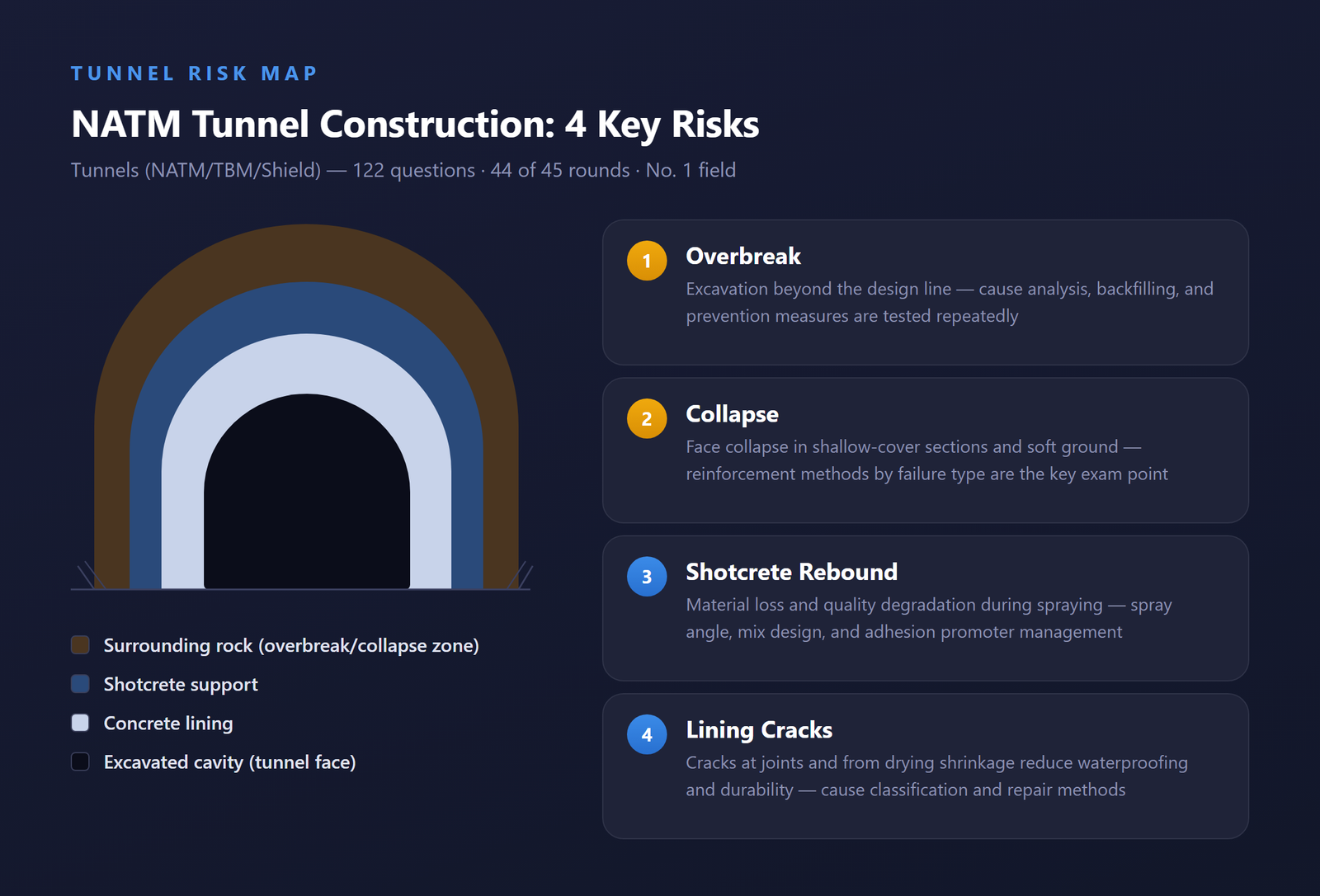
Tunnels (NATM/TBM/Shield) hold an unshakable first place with 122 questions (8.7%) and appeared in 44 of the 45 rounds. That means it is, in effect, the most frequently tested field, one that never drops out of any exam. It is also the area with the highest value for repeated study, given its wide range of sub-topics: NATM overbreak, collapse, and support; shield/TBM construction; portal sections; shotcrete rebound; lining cracks; and more.
Looking at the concentration on a larger scale, it goes like this.
The top 10 fields (Tunnels through Water and Sewer Pipelines) account for 51.5% of all questions. Extending this to the top 20 fields brings it to 76.8%. In other words, by concentrating on just 20 fields, you can prepare for more than three quarters of the past questions.
Looking only this far, it is easy to drift toward the conclusion, “So can’t I just dig into the top 20?” But this is exactly the dangerous misconception that this data holds. There are two reasons.
First, if you look at the “number of exams featuring the field,” there are broad-based fields that, even with fewer questions, produce at least one question in almost every exam. Bridge structures/maintenance (41/45), ports/breakwaters (41/45), bridge erection methods (40/45), and construction management (38/45) appear steadily rather than clustering in particular rounds, whereas dam construction (49 questions/33 rounds) and rivers (66 questions/33 rounds) have many questions but tend to cluster, with two or more questions in specific rounds. In other words, if you simply memorize the “ranking by number of questions,” you may run into unexpected gaps in the actual exam room.
Second, there are the remaining 15.8%, the 220 “Other” items. These are individual technical terms that cannot be grouped into a particular field, and they can turn up at any time in the Session 1 short-answer section. If you go all-in on the top 20 fields and give up on this part entirely, you could end up unable to touch far more Session 1 questions than you expected.
So the real lesson of the Pareto analysis is not “study 20 fields and you’re done,” but a matter of balance: “allocate an overwhelming share of your study time to those 20 fields, but never let go of the rest entirely.”
5. What Exactly to Prepare for in the Most Frequently Tested Work Types
Knowing only that a top-ranked field “comes up a lot” is not enough preparation. You need to identify the specific sub-topics that are repeatedly tested within each field. Representative past-question examples from the top several fields are summarized below.
- Tunnels (122 questions, 44/45 rounds): NATM portal ground reinforcement, causes of overbreak and prevention measures, reducing shotcrete rebound, shield/TBM segment erection, tail void, problems with twin-arch and parallel tunnels, collapse patterns and reinforcement methods in shallow-cover sections, concrete lining cracks, probing ahead of the tunnel face (TSP)
- Bridge Structures/Maintenance (89 questions, 41/45 rounds): damage to and replacement of bearings, expansion joint gap management, lateral movement of abutments, bridge scour countermeasures, seismic performance improvement, BMS (Bridge Management System)
- Construction Management/Scheduling, Contracts & Cost Estimation (82 questions, 38/45 rounds): schedule compression techniques (MCX), causes of claims and resolution measures, contract amount adjustment, CM/responsible supervision, EVMS, review of subcontracting adequacy, ADR
- Ports/Breakwaters/Dredging/Caissons (72 questions, 41/45 rounds): caisson fabrication, transportation, and launching; characteristics of each breakwater structure type; types and selection of dredgers; quay wall (open pier/caisson/sheet pile type) construction; rubble mound breakwaters
- Bridge Erection Methods (65 questions, 40/45 rounds): FCM (Free Cantilever Method), ILM (Incremental Launching Method), MSS (Movable Scaffolding System), cable erection for cable-stayed and suspension bridges, PSC girder camber management, steel bridge erection methods
These five fields alone share one thing in common: each appeared steadily in at least 38 of the 45 rounds. That is, they are not “fields that occasionally show up in a big way” but “fields that produce one or two questions every time,” and for that reason it pays to organize in depth the principles of each construction method as well as the latest construction issues.
6. Recent Trends Are Shaking Up the Traditional Pareto
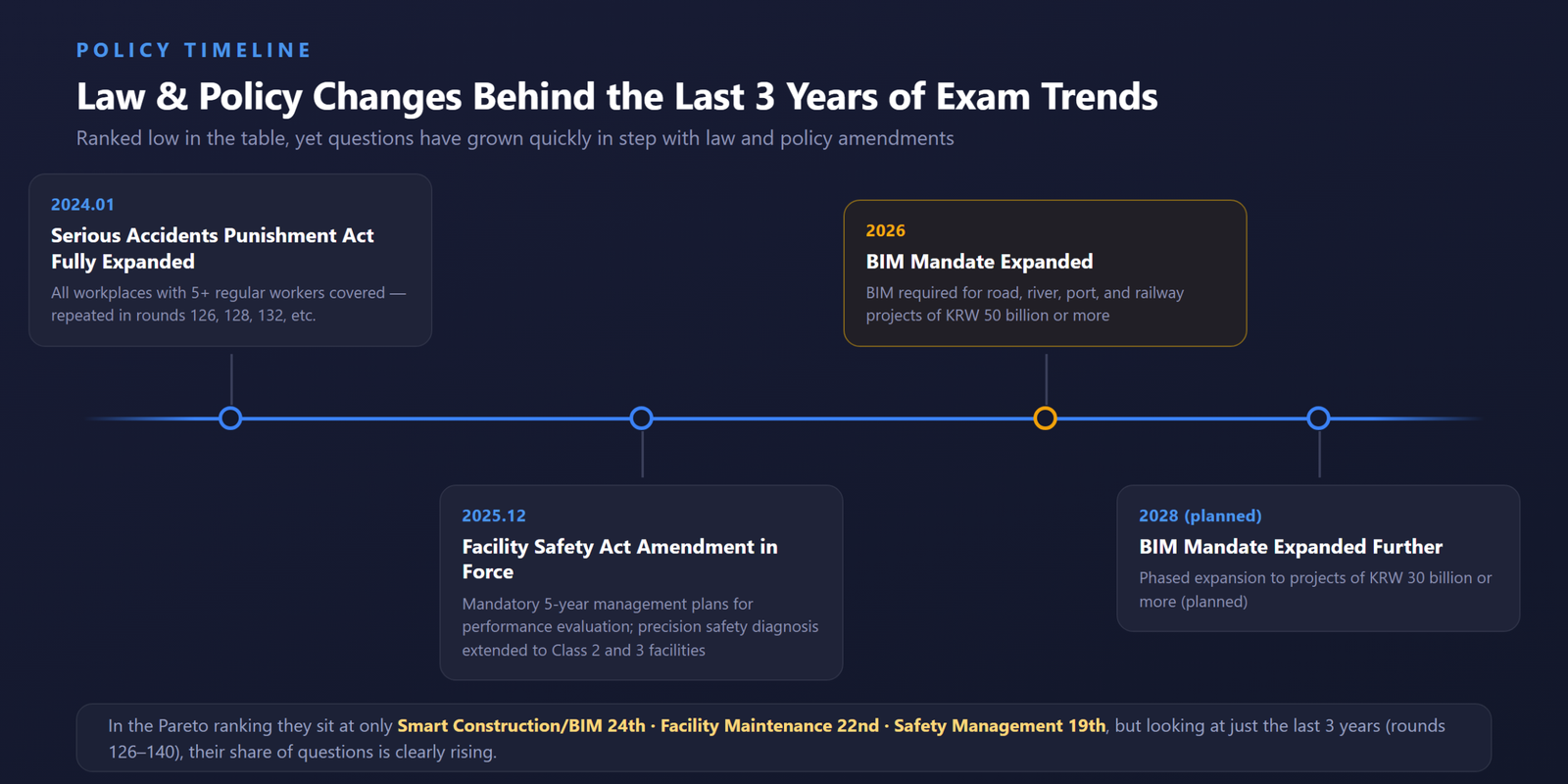
The Pareto table that aggregates 45 years’ worth of data is a powerful weapon, but exam trends are not fixed. Narrowing the view to recent rounds (the 126th through 140th, the last three years), a clear pattern emerges in which areas that once carried little weight are coming to the fore.
Smart Construction/BIM: Questions on digital twins, 5D/8D BIM, intelligent compaction, and machine guidance have noticeably increased recently. In fact, under its BIM mandate roadmap, the Ministry of Land, Infrastructure and Transport has already made BIM mandatory for road, river, port, railway, and building projects worth KRW 100 billion or more, and it plans to expand the mandate in stages to projects worth KRW 50 billion or more in 2026 and KRW 30 billion or more in 2028. For the maintenance stage as well, the direction being presented is to develop robot- and drone-based facility inspection into a digital twin-based system, so this field is likely to keep growing in its share of questions.
Facility Maintenance/Safety Inspection (Performance Evaluation): The Special Act on the Safety Control and Maintenance of Establishments was amended by Act No. 20553 (partial amendment of December 3, 2024) and took effect on December 4, 2025. Facilities subject to performance evaluation must establish and implement a mid-term management plan every five years, and the scope of facilities subject to precision safety diagnosis has been expanded beyond the existing Class 1 facilities to include Class 2 and Class 3 facilities that are 30 years past completion and have a safety grade at or below a certain level. Amendments like these are read as the background to the increase in questions on this field in recent rounds.
Serious Accidents Punishment Act: Since January 27, 2024, it has applied in full to all workplaces with five or more regular workers, and our own analysis also confirmed repeated questions in the 126th, 128th, and 132nd rounds, among others. From 2026, the system is reportedly set to be strengthened further so that the name, industry, size, and accident cause of workplaces where serious accidents occur are made public, so essay questions on safety management are likely to keep appearing steadily.
ESG/Eco-Friendly: Carbon-neutral technologies such as low-carbon concrete and eco-concrete are also keywords that have recently come into the spotlight. The Ministry of Land, Infrastructure and Transport’s 2026 R&D program implementation plan also sets carbon neutrality and achievement of the national greenhouse gas reduction target (NDC) as major investment pillars, so low-carbon technologies such as high-strength cement-free concrete are likely to continue serving as material for essay questions.
One point worth noting is that these four trend fields do not yet rank high in the Pareto table we looked at earlier (Smart Construction/BIM 24th, Facility Maintenance 22nd, Safety Management 19th). That is, they look “non-mainstream” in the 45-year cumulative data, but looking at just the last three years, they are areas whose weight is growing quickly in step with changes in laws and systems. If you trust only the past Pareto rankings and miss this flow, you could be tripped up by questions on recent trends even if you prepared mainly on the top-ranked fields.
7. So What Should You Study? Redesigning Study Priorities
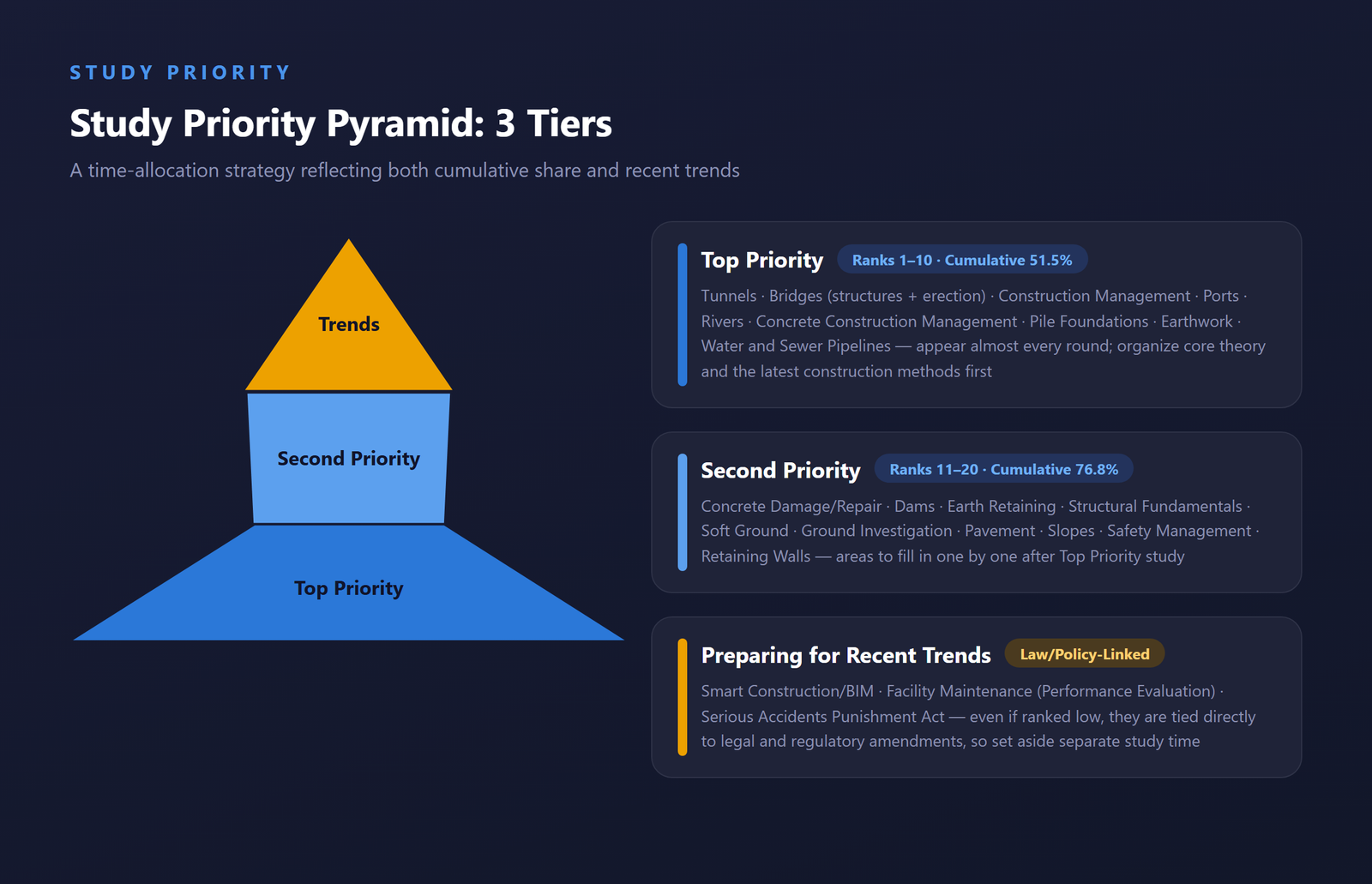
Putting the data so far together, study priorities can be organized as follows.
- Top-priority focus fields (cumulative 50% zone, ranks 1–10): tunnels, bridges (structures + erection), construction management, ports, rivers, concrete construction management, pile foundations, earthwork, water and sewer pipelines — these appear in almost every round, so organize the core theory and the latest construction methods first.
- Second-priority focus fields (ranks 11–20, cumulative 77% zone): concrete damage/repair, dams, earth retaining structures, structural fundamentals, soft ground, ground investigation, pavement, slopes, safety management, retaining walls — areas to fill in one after another once your first-priority study is done.
- Preparing for recent trends: Questions on smart construction/BIM, facility maintenance (performance evaluation), and the Serious Accidents Punishment Act are directly tied to amendments of laws and regulations, so even if they do not rank near the top, you need to set aside separate time to organize the latest amendments.
- Preparing for Session 1 short-answer questions: The 220 “Other” items rarely recur, so manage them in a separate glossary (short-answer notebook), and memorize first the terms derived from the top 30 fields (e.g., tunnel- and concrete-related short-answer terms), which is the more efficient approach.
To sum up, the main axis of your study time should go to the top 20 fields (76.8%), but within that you need to fine-tune your priorities by considering not only the “number of questions” but also the “number of exams featuring the field” (how steadily it appears). Only when you layer the variable of the latest laws and trends on top of that does the strategy become complete. Basic exam information such as eligibility requirements and exam schedules is officially announced round by round on Q-net’s qualification detail page, so it is a good idea to check that as well.
Conclusion
The result of the complete analysis of 45 exam rounds and 1,395 items is clear. Tunnels hold an unshakable first place, and the Pareto principle, that the top 10 fields account for more than half of all questions and the top 20 fields for more than three quarters, applies to this exam as well. But it is dangerous to accept these numbers as the simple conclusion that “you only need to dig into the top ranks.” A true strategy is complete only when you also look at the fields that come up steadily even with few questions, and at the smart construction and safety-related fields that rank low in the table but have surged recently in step with changes in laws and systems.
What matters in the end is not blind faith in data but the sense of balance to lay the structural patterns the data reveals over the latest trends. For an exam with a written pass rate of only 7–11%, building a priority strategy grounded in 45 years’ worth of past questions, rather than vague gut feeling, is what will substantially raise your chances of passing.